
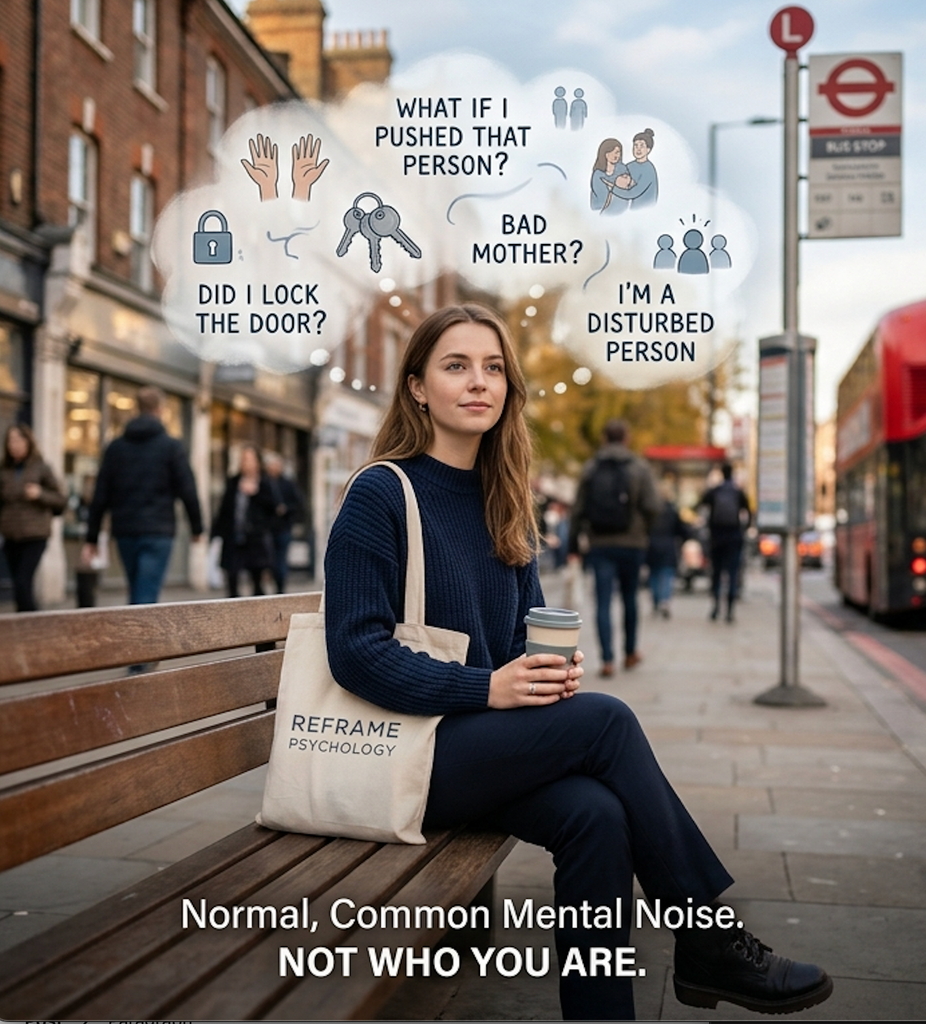
If you have ever had a sudden, shocking thought pop into your head (such as an impulse to step off a curb, a terrifying image of harm coming to someone you love, or a bizarre sexual or moral scenario), you know how unsettling it feels. Your heart races, a spike of guilt or horror hits your chest, and a terrifying question follows: “What does this say about who I am?”
Here is the most important thing you need to know: having intrusive thoughts does not mean you want to act on them, nor does it reflect your core values or character.
In clinical psychology, we understand these unwanted mental pop-ups as a normal, automatic part of human neurology. Let’s look at what the research actually says about why they happen, why we get stuck in them, and how you can gently change your relationship with your mind.
1. You Are Not Alone: The 94% Rule
When people experience intrusive thoughts, shame thrives in secrecy. Many clients come to therapy believing they are uniquely broken or harboring secret, dangerous desires.
However, foundational research led by Dr. Adam Radomsky and an international team of researchers spanning 15 countries found that over 94% of the general population experiences unwanted intrusive thoughts (Radomsky et al., 2014).
Whether it is a thought about harm, contamination, mistake-making, or inappropriate behaviour, unwanted mental intrusions are a near-universal feature of how human brains process information. Your brain generates thousands of random thoughts, images, and visual projections every single day. Most are discarded as mental background noise; some simply trigger a temporary, odd blip.
2. Why Do Intrusive Thoughts Feel So Real and Frightening?
If intrusive thoughts are normal, why do they cause so much distress?
The answer lies not in the content of the thought, but in how we interpret it. Pioneer psychologist Dr. Stanley Rachman developed the cognitive model of obsessions, which highlights that catastrophic misinterpretation is what turns a fleeting thought into an ongoing loop of anxiety (Rachman, 1997).
When a thought appears that directly contradicts your deepest moral values (known in psychology as an ego-dystonic thought), your brain flags it as an alarm.
- The Thought: “What if I lose control and drop this child?”
- The Ego-Dystonic Truth: You value safety and care deeply for the child.
- The Misinterpretation: “Because I thought it, I must be a dangerous or bad person.”
Paradoxically, the reason these thoughts disturb you so intensely is precisely because they go against everything you value and stand for. A violent intrusive thought bothers a peaceful person; an inappropriate thought bothers a conscientious person.
3. The Trap of Thought Suppression
When an intrusive thought triggers shame or fear, the most natural instinct is to try and push it away, prove it wrong, or pledge to “never think that again.”
Unfortunately, cognitive psychology shows us that trying to control your mind this way creates a phenomenon known as the “white bear effect” or thought suppression rebound. When you actively try not to think of a white bear, your brain constantly has to monitor itself to check if it is thinking of the bear, which guarantees the thought keeps coming back.
Attempting to suppress, neutralise, or endlessly analyse an intrusive thought signals to your brain’s threat centre (the amygdala) that the thought is indeed a real hazard. This keeps the alarm system ringing, amplifying the thought’s frequency and emotional charge.

4. Evidence-Based Ways to Reframe Intrusive Thoughts
Shifting away from shame and struggle requires changing how you respond when an intrusive thought occurs:
A. Acknowledge and Label
Instead of fighting the thought, label it objectively: “That is an unwanted intrusive thought.” Giving it a clinical label helps separate your identity from your mental traffic. You are the sky; thoughts are just passing weather.
B. Practice Cognitive Unhooking (Defusion)
Rather than engaging with the content of the thought or trying to figure out “why” it happened, practice stepping back. You can say to yourself: “My brain is generating a ‘what-if’ scenario right now. I don’t need to engage with it.”
C. Align with Your Values, Not Your Fears
Remind yourself that intrusive thoughts are ego-dystonic. They represent the exact opposite of your intentions and values. The presence of distress is evidence of your care and integrity, not proof of hidden malice.
D. Allow the Anxiety to Peak and Fade
Anxiety works like a wave. When an intrusive thought strikes, allow the wave to rise without rushing to perform checking behaviours, reassurance-seeking, or mental rituals. Over time, your nervous system learns that the thought is a false alarm and doesn’t require an emergency response.
When to Seek Support
While intrusive thoughts are a normal part of life, they can sometimes become persistent, overwhelming, or central to conditions like Obsessive-Compulsive Disorder (OCD), Health Anxiety, Perinatal Anxiety, or Post-Traumatic Stress Disorder (PTSD).
If intrusive thoughts are taking up significant time, causing intense distress, or disrupting your daily life and relationships, working with a qualified therapist trained in Cognitive Behavioural Therapy (CBT), Acceptance and Commitment Therapy (ACT), or Exposure and Response Prevention (ERP) can provide effective, structured relief.
You do not have to navigate the weight of intrusive thoughts alone, and you certainly do not have to feel ashamed of a brain that is simply trying (and sometimes overreacting) to keep you safe.
Peer-Reviewed References & Further Reading
- Radomsky, A. S., Alcolado, G. M., Abramowitz, J. S., Belloch, A., Bouvard, M., Clark, D. A., … & Wong, W. (2014). Part 1. You can’t run, but you can hide: Intrusive thoughts in a non-clinical, multinational sample. Journal of Obsessive-Compulsive and Related Disorders, 3(3), 269–279.https://doi.org/10.1016/j.jocrd.2013.09.002(This landmark international study demonstrated that unwanted intrusive thoughts are experienced by over 94% of individuals globally.)
- Rachman, S. (1997). A cognitive theory of obsessions. Behaviour Research and Therapy, 35(9), 793–802.https://doi.org/10.1016/S0005-7967(97)00040-5(Outlines how catastrophic misinterpretations of normal intrusive thoughts create ongoing distress and obsessional loops.)
- Berry, L. M., May, J., Andrade, J., & Kavanagh, D. (2010). Emotional and behavioural reaction to intrusive thoughts. Assessment, 17(1), 126–137.https://doi.org/10.1177/1073191109344694(Explores how negative reactions and thought suppression strategies worsen emotional responses to intrusive cognitions.)
- Hinuma, S., Ogishima, H., Shimada, H., Tanaka, Y., Osao, M., Moriishi, C., & Obata, S. (2025). Classification of intrusive thought patterns based on differences in the mechanisms of occurrence and persistence. Frontiers in Psychiatry, 16, 1520496.https://doi.org/10.3389/fpsyt.2025.1520496(A contemporary examination analyzing how rigid evaluation and excessive control mechanisms maintain intrusive thought patterns.)
Leave a Reply